..a personal story about doing an afforest project instead of pursuing shorter term financial value through Christmas tree production.
At Christmas 2025, a Nordmann fir (Abies nordmanniana) Christmas tree was priced at up to €30 per metre. Nordmann fir trees are by far the most popular Christmas tree in Germany and from planting a sapling to harvest it takes about ten years. Nordmann firs have high economic value, require relatively little care between planting and crop harvest, and financial return is neatly measurable.
My mother owns a 1.7 hectare piece of land that was planted with Nordmann fir. The last trees were harvested in 2020. It would have been easy to do what ‘makes sense’ from a money perspective: replant and continue. But she didn’t. Because what she wanted wasn’t secure financial revenue. She wanted the land to become valuable in a different way: as a living asset for the future of her three grandchildren.
Christmas tree cultivation is the perfect example of linear short(ish)-term value creation. You invest in a crop, harvest it, sell it, it becomes a Christmas tree, then it’s discarded in January..and repeat. The financial business case is understandable to everyone. Yet it also shows how decision making can become narrowed to what is measurable and monetisable. My mother’s decision is a fine example of choosing differently. Her goal was explicit: make the land a haven for nature. She consciously decided against planting another Christmas tree crop or converting the land to other agricultural use. The last Nordmann fir crop had also been not of high quality, which made this decision easier, but it did not create it.
I think this is a form of personal future stewardship: acting with the future in mind, without requiring the present to pay you back. I don’t think the term exists ‘officially’ and had a half-baked idea of turning this into an academic paper, like an individual-level companion to Earth stewardship. But then this personal story would have no doubt be needed to watered down in favour of ‘academic rigour’. But, still, personal future stewardship fits what my mother did.
The first idea was a meadow. But because the land is surrounded by arable fields, it wasn’t suitable for establishing a wild meadow in the way intended. So the idea evolved from meadow to forest. We identified public funding under the German rural resilience programme (700 page document. Oh boy!) with the task of “Improvement of Agricultural Structures and Coastal Protection”. The intention of the programme is that rural areas remain viable, with environmentally and resource-conserving land and forestry as integral parts of these regions. This mattered for two reasons. First, it made the project financially possible. Second, it anchored the project in a logic of long-term stewardship rather than short-term return.
The public sector forestry advisor suggested planting “a nice oak forest” to us. We pushed strongly for the inclusion of pockets of different tree species, and managed to keep a constructive dialog going. I like to think that, through this dialog, we positively impacted other future forests to be supervised by this public sector forestry advisor. This was where my key input was: increasing the climate resilience of the small 1.5 hectare forest to be. So, the 2022 planting of 6,800 trees included several other tree species in addition to English oak (Quercus robur): European beech (Fagus sylvatica), Black alder (Alnus glutinosa), Field maple (Acer campestre), and European white elm (Ulmus laevis).
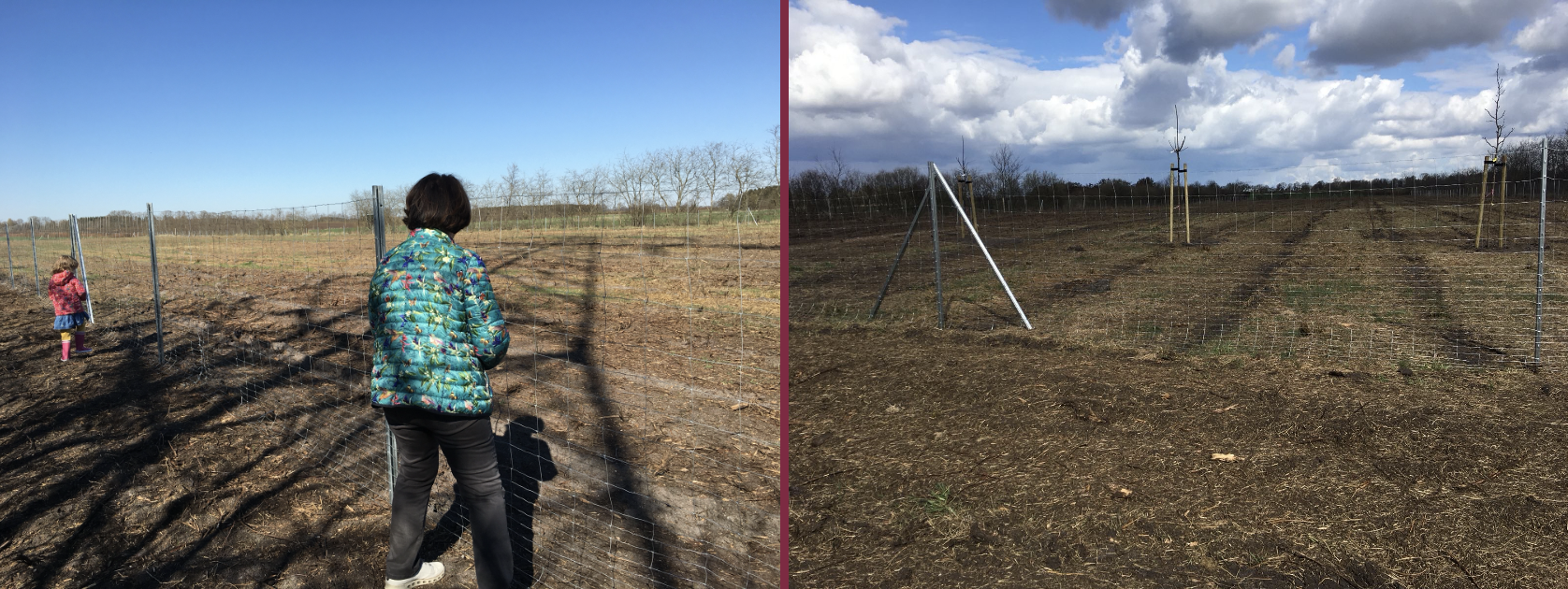
April 2022: Freshly planted trees
More on numbers..
Here is what personal future stewardship looks like when translated into administrative reality:
2022 cost for land prep, trees, planting 4000 trees via machine, planting 2800 trees by hand, fencing: around €14,850
2023 first year maintenance cost, focus on removal of bird cherries and poplars in March, mowing in August: around €3,170
85% funding received on net cost (0.85 × €18,020): around €15,320
15% co-financing of net cost (0.15 × €18,020): around €2,700
VAT (19%) on total net paid (0.19 × €18,020): €3,420
6,800 trees planted on 1.5 hectares
Tree height at planting: 40-80 cm
6 low-growing fruit trees planted under the power line
A meadow strip added as edge habitat
582 metres of fencing to protect young trees from deer
Own cost, to date, co-financing plus VAT: around €6,130
We are thrilled that, despite a drought, torrential rains, a very cold winter spell (we’re now in January 2026 and in the midst of the second cold spell since 2022) the trees are thriving. Some are already higher than 5 meters and the number of insects and birds you can hear and see in the summer months is a huge contrast to the neighbouring agriculturally used land.
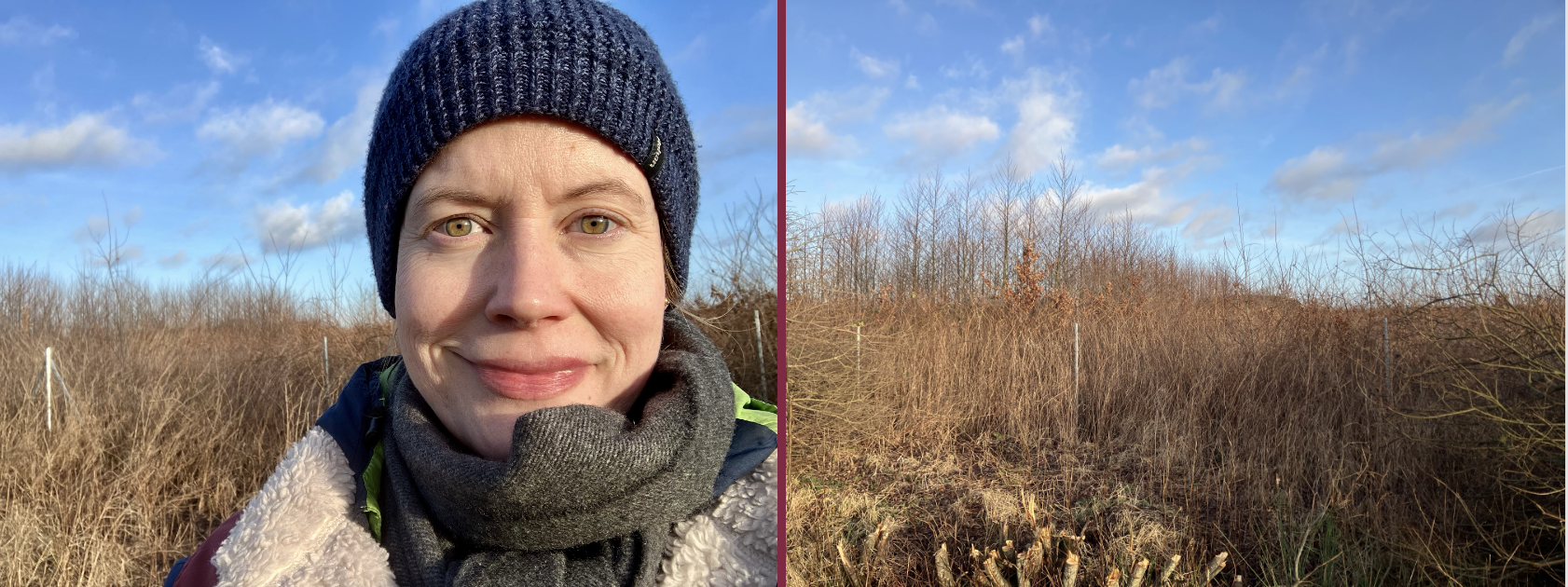
December 2025: Thriving young trees (and I 😊) in distinct species pockets
The young trees will need to be thinned out soon because it is getting rather crowed. Other than needed forest maintenance, the planted trees cannot be felled or the land used commercially by us landowners for 30 years. According to the funding agreement, the only land use still possible would be installing a wind turbine for renewable energy generation.
At Christmas 2025, my mother had her first wooden reusable Christmas tree. My own family has had one since 2019. So we don’t participate in the annual cycle of cut-and-discard of Christmas trees anymore. Because in early January, you see them everywhere: Christmas trees stacked at the roadside, waiting to be collected. To me, the original financial Nordmann fir crop business case looks now viscerally strange when I walk past these thrown out trees: years of growing, weeks of display, then waste. I don’t say this to shame anyone. The smell and greenery indoors is something I, too, like. A lot. As do many other people! With reason, there is the long-running annual IKEA marketing campaign ‘Knut’ based on the throwing out of the Christmas tree in January. I am just a bit closer to what is behind that beautiful Christmas tree, and I am glad that my mother chose something else.
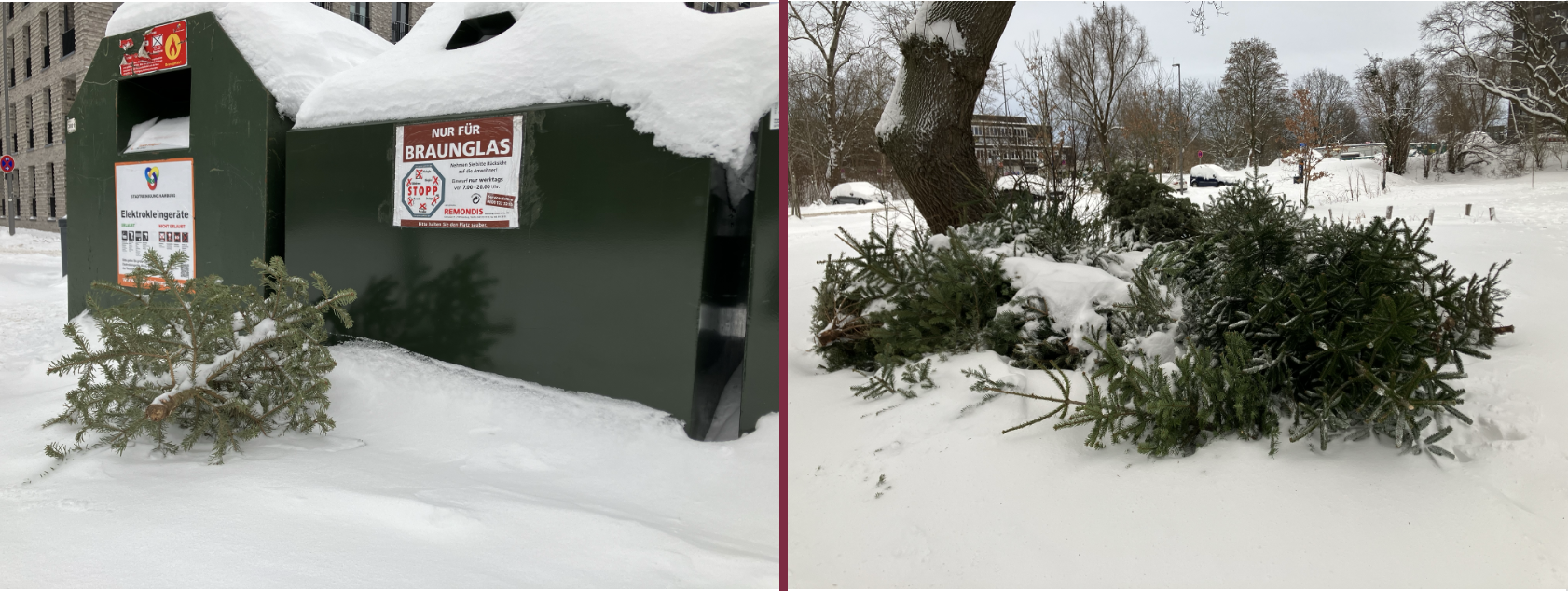
January 2026: Christmas trees for collection in Hamburg, Germany
But this is not a story about trees. Rather, it is about refusing the demand that everything meaningful must justify itself through a financial business case. There is no short-term, financial or otherwise, business case for what my mother did. But there is a social and environmental value case. A biodiversity case. A climate resilience case. It is what I call personal future stewardship: a practice of making decisions whose value benefits you may never personally collect. Or, in my mother’s case who is 80 years old, certainly will not personally collect. And perhaps that is the most radical form of sustainability there is.